

Okay, last post on trailers, I swear. The following were all way too long to be included in either the spoiler-free article or video, but I think they’re all entertaining, and worth watching on a hot Saturday afternoon.
More Meta
I’ve often professed my love for movies-about-movies, but what about movies-about-movies-about movies?
Faux Filming
Rain of Madness is a behind-the-scenes documentary about the making of a fictional film-within-the-film. It’s delightfully unhinged, but also totally in-character. It’s
Rain of Madness is to Tropic Thunder what Hearts of Darkness was to Apocalypse Now, and it’s a pretty good take down of pretentious filmmakers.
Before Blair Witch
Early in development, The Blair Witch Project was intended to be a more straightforward faux-documentary, with a narrator and archival photos, and Ken Burns-y things like that. At some point in post, the filmmakers pivoted to the complete found-footage aesthetic, which meant they had a whole lot of unused footage. They found a pretty good use for it, promoting the fake feature documentary with an even faker TV documentary—
Similar to Rain of Madness, the filmmakers repurposed the footage as a behind-the-scenes documentary of the fictional movie. The Curse of the Blair Witch originally aired on the Sci-Fi channel, and was later included as a DVD bonus feature (which is where I saw it). In some ways, I actually find it creepier than the final film.
Interquels
As a general rule, I dislike immediate sequels. One especially egregious example is The Incredibles, which didn’t end on a real cliffhanger, but rather a “And the Adventure Continues” high note. The sequel absolutely did not have to begin with the Underminer’s attack. The fact that both movies take place over the course of a week makes the world seem small.
I much prefer that stuff happens between movies, off screen. The relationships in Empire Strikes Back feel much more meaningful because Han, Luke, and Leia were off on adventures we never got to see. Conversely, Han isn’t the only one who seems frozen in carbonite at the start of Jedi.
Plus, if time passes in the story world as well as the real one, it gives the filmmakers an opportunity to create bonus content!
Drawing the Matrix
The Animatrix was one of the coolest side projects for any film franchise ever. The Matrix introduced audiences to the virtual world, but the viewpoint was necessarily restricted to the protagonist, Neo. The Animatrix, on the other hand, as an anthology of animated short films, explored the premise from multiple perspectives, ranging from regular people to the robots themselves.
The original Matrix was heavily influenced by anime, so the mostly-Japanese animators fit neatly into the style. Although they all used some computer graphics, Final Flight of the Osiris was the only overtly 3D animated film, which was quite innovative (and expensive) at the time. Although not “required viewing,” the plot leads directly into The Matrix Reloaded.
Why So Serious?
The 2000s were a golden age for alternate reality games promoting movies, from A.I. to Cloverfield to The Dark Knight. The last ARG was so elaborate, including games, puzzles, fake websites, and even real-life campaign rallies for the fictional district attorney Harvey Dent.

It was extremely elaborate; you can explore the ARG wiki page for hours. The company behind the campaign, 42 Entertainment, even filmed news segments for the fictitious Gotham News Network.
Although nearly a million people participated in the ARG, over 74 million people saw the movie in theaters, so it obviously wasn’t necessary to understand the movie’s story.
Faux Futures
The original Blade Runner was set in November of 2019, which you may notice is no longer in the future.
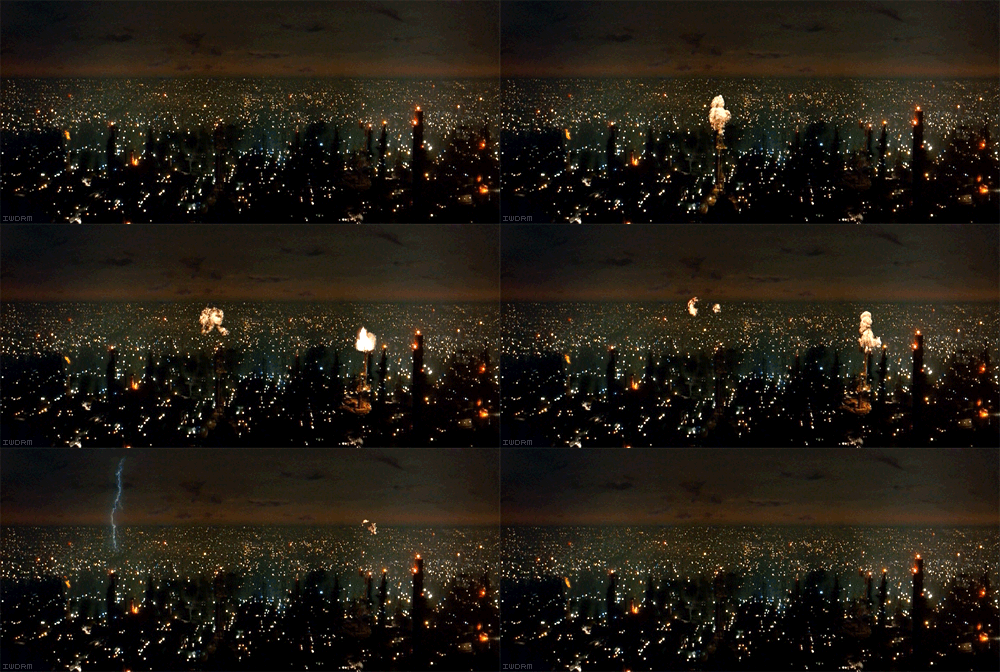
To promote the sequel, Blade Runner 2049, Warner brothers commissioned three short films to cover the time between movies, set in 2022, 2036, and 2048.
Although the first one is animated, the last one, directed by the original director Ridley Scott’s son Luke,1 is most similar to Final Flight of the Osiris, in that it directly sets up the first scene of the sequel.
Once again, the short isn’t exactly necessary to understand the film, but it enhances the experience. It’s the exact opposite of our last example…
Missing Pieces
Alien: Covenant is kind of a mess, largely due to studio meddling, as you’d probably assume. Director Ridley Scott wanted a true sequel to Prometheus, while 20th Century Fox wanted an alien movie with, you know, aliens in it. (I still don’t know who formed a covenant, though.)
This scene that bridged the two movies was cut, and released as a “prologue.” Admittedly, it not totally necessary, but it does explain what happened to the protagonist of the first movie.
But the next “prologue” really should have been in the movie—
[Spoiler alert for a decade-old film you would’ve seen by now if you cared.]
In Covenant, James Franco plays a corpse, having died in his sleep pod in the accident that kicks off the film. His death would’ve been quite a surprise if the above prologue had remained in the movie, Franco being the star that he is (or at least, was).
As it stands, watching the film you’re just like, “Wait, is that dead guy James Franco? Is he going to come back in a flashback or something?” Nope, he’s just there to confuse you.
Special Features
Writing this up, it occurs to me that, twenty-five or even fifteen years ago, this extra scenes really added something to the story world, making it feel bigger and lived in. It felt like we were being served a delicious appetizer before the main course. But more recently, with crap like Jurassic World: Dominion and Alien: Covenant showing deleted scenes that should have been in the movie, it’s like we’re eating leftovers from tomorrow’s dinner.
It might be a cost-saving measure, but I think the studios are tripping over dollars to pick up pennies. Yes, WB had to spend a lot on Why So Serious, but it greatly added to the hype. If you weren’t there, you wouldn’t believe how excited people were to just watch the first six minutes of Dark Knight before I Am Legend.
Marketing isn’t easy, but it can be just as creative and inventive as the film itself. It takes investments of time, money, and most importantly, effort. I’d really love to see studios trying more creative advertising again.
What, nepotism? That doesn’t sound like the Hollywood I know!